
Book Quotes
The following are a few quotes from the book, Conversations Beyond Time; secrets of success. To purchase the book go to this link

Conversations Beyond Time: Secrets of Success
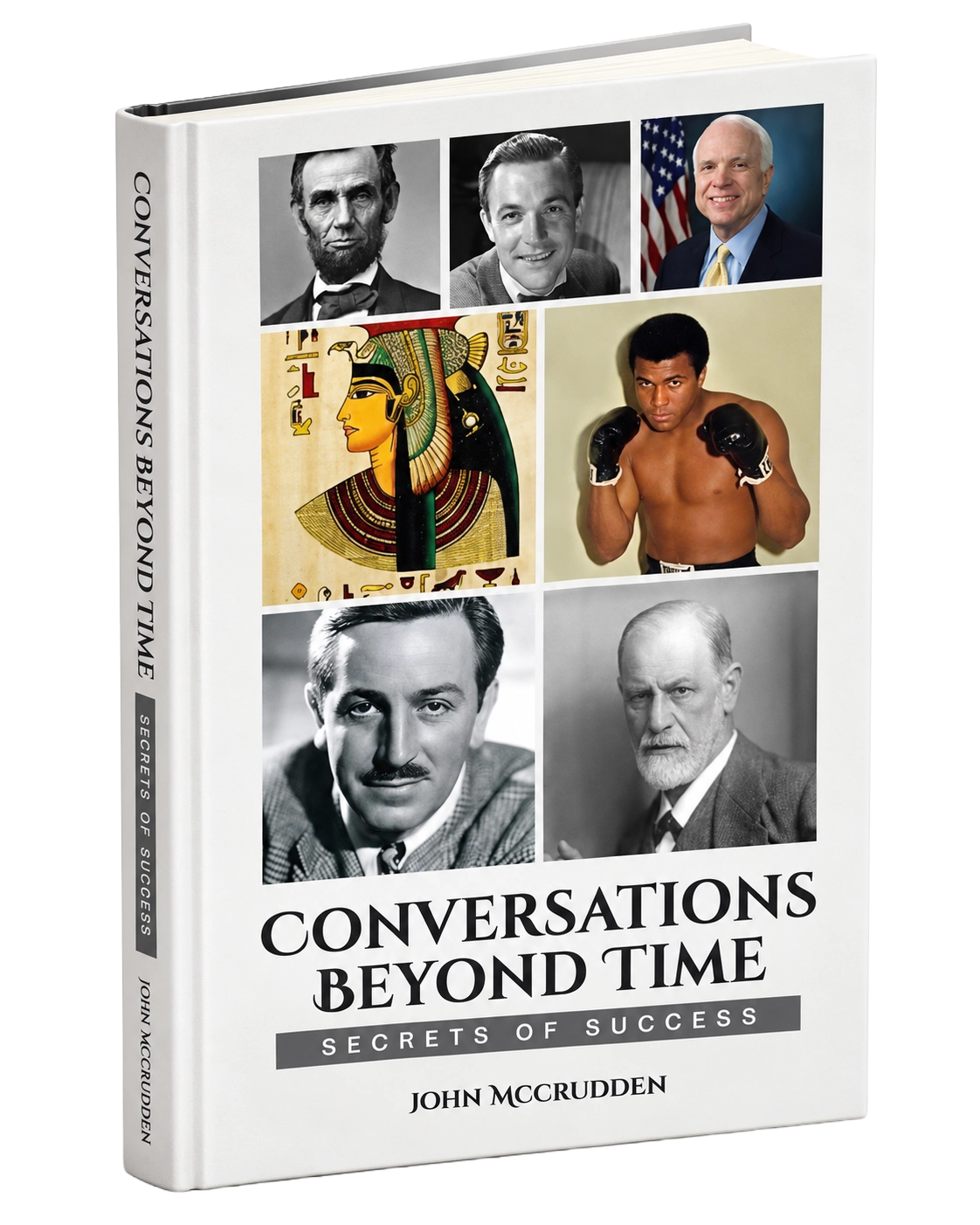
The following are a few quotes from the book, Conversations Beyond Time; secrets of success. To purchase the book go to this link
Purchase the Book on AmazonWhat Would Plato Say to Young People?
What would Plato Say to young People?
Quote From Plato
Interviewer: How would Plato advise the new generation with finding their place in the 21st century?
Plato:
You live in an age of extraordinary noise and an unceasing flow of images, opinions, distractions. The danger of such a world is not that it offers too little, but that it offers too much. Amidst so many voices, one may forget to listen to the soul.
My advice? Begin not with the world, but with yourself. Know thyself. This ancient command remains as urgent now as it was at Delphi. Do not ask first what the world wants from you, ask what your nature inclines you toward and what form of the good you are called to serve.
Do not mistake utility for purpose, or popularity for truth. The world will try to sell you many roles: consumer, follower, brand, but none of these are who you truly are. You are a soul, temporarily housed in a body, capable of reason, love, and contemplation of the eternal.
If you wish to find your place, do not begin by asking where you fit, but rather what you must become in order to bring justice, beauty, and wisdom into the world. Shape yourself like a sculptor shapes stone, guided not by fashion, but by the ideal Form you seek to emulate.
And lastly, seek good companions. Philosophy is not a solitary road. Walk with those who challenge you to rise, not those who lull you into comfort.
How Important Is Passion to Career Success?
How important is Passion to career success?
Quote from Jim Brown
You know, passion isn’t something you just stumble on, it’s something you grow into. For me, it started in childhood. I was raised by a strong single mother who worked multiple jobs just to keep food on the table. I saw what hard work looked like from day one.
Sports became my outlet. I played everything: lacrosse, basketball, track, and of course, football. But it wasn’t just about the games. It was about competition, about pushing myself, about finding out who I was when things got tough.
Football, in particular, gave me a stage. It wasn't just about scoring touchdowns; it was about dignity, respect, and proving that a Black man could not only play the game but dominate it with intelligence, strength, and grace.
Later in life, that same fire translated into activism and acting. I didn't want to just play roles; I wanted to own my image, to speak truth to power, to uplift my community. So in a way, I didn’t find my passion; I followed the fire, wherever it led.
What Was Your Greatest Accomplishment?
Interviewer: What would you say was your greatest accomplishment?
Jim Brown (Posthumously):
People always expect me to say something about football, maybe leading the league in rushing eight out of nine seasons, or retiring at the top of my game. And don’t get me wrong, I’m proud of that. But football was just a chapter.
My greatest accomplishment? That would be founding the Amer-I-Can Program. Helping young men, especially gang members, incarcerated youth, and people society has written off, turn their lives around. Teaching them life skills, giving them the tools to believe in themselves, and showing them a way forward. That’s real impact.
Trophies gather dust. Records get broken. But if you help someone change the direction of their life, that ripple effect can go on for generations. I wanted my legacy to be bigger than yards and touchdowns. I wanted it to be about change.
How Did Senator John McCain Overcome Failure?
Interviewer: How did you overcome failure?
By failing again — and learning every time.
I failed plenty. I graduated near the bottom of my class at the Naval Academy. I made reckless choices as a young pilot. I let pride and anger get the best of me more than once. And in politics, I lost some of the biggest races of my life — including the presidency.
But I never saw failure as the end. It’s part of life, especially if you’re doing anything that matters. What counted was how I responded. Did I take responsibility? Did I learn something? Did I get back up and keep going? That’s where character is built — not in the wins, but in the losses.
I also leaned on others. My family, my fellow service members, my colleagues in the Senate — they reminded me that humility is a strength, not a weakness. That no one succeeds alone. And that in this country, we always get a second chance — if we’re honest, if we own our mistakes, and if we stay true to our principles.
What Would Ruth Bader Ginsburg Advise About Overcoming Failure?
What would Supreme Court Judge Ruth Ginsberg advise about overcoming failure?
Interviewer: How did you overcome failure?
Ruth Bader Ginsburg:
I’ve always believed that setbacks are simply part of the journey, not the end of it. When I graduated at the top of my class from Columbia Law School in 1959, not a single law firm in New York would hire me. I was a woman, I was a mother, and I was Jewish. Each of those was considered a strike against me at the time.
It was disappointing, yes. But I didn’t allow rejection to define my path. Instead, I looked for another door, one that led me into academia and, eventually, into advocacy. I turned toward teaching, research, and litigation, and discovered that I could make a real difference there.
I also learned from my mother, who taught me two things: to be a lady and to be independent. That meant rising above pettiness and focusing on the work. When I faced failure or frustration, I didn’t let it consume me. I kept my eyes on the larger goal of justice, equality, and using the law to make life a little better for others.